Showing posts with label Sonoma. Show all posts

Monday, August 17, 2015

Berkeley enacts balcony safety requirements

A Smart Idea for Sonoma County


Workers cut away a strip of outer stucco while preparing a balcony for removal outside a residential apartment building in Berkeley.
BERKELEY -- Starting July, several thousand properties are now subject to periodic inspections of decks and other exposed structures under new rules crafted in response to the June 16 collapse of a fifth-floor balcony at a downtown apartment complex that killed six young adults and injured seven more.
The City Council on Tuesday approved urgency ordinances that require property owners to hire a licensed expert to inspect and certify the structural integrity of decks, balconies, staircases, landings and other weather-exposed areas within six months, and thereafter every three years. The ordinances apply to any residential building with more than three units.
Industry representatives warned that acting prematurely and hastily and without input from experts could have unanticipated and adverse outcomes. But a sense of urgency that the city must take firm action in response to the disaster and do something to protect the public against the possibility of similar ones occurring prevailed throughout the night's often-passionate debate.


The mandated inspections would be performed by a licensed general contractor, structural pest control specialist, architect or engineer. Several residents questioned how the city staff would be able to oversee the program given its current resources.
Councilman Laurie Capitelli suggested enlisting the help of the American Society of Home Inspectors, noting that it had done private inspections of 14 balconies in the city's Elmwood section since the accident and had recommended two of those balconies for closure.
NEW RULES New inspection rules:
Existing decks, balconies, landings and other weather-exposed areas must be inspected and certified by a licensed expert within six months, and thereafter every three years
New building standards:
  • set standards for ventilation of weather-exposed structures such as balconies, landings, decks and stairs.
  • require balconies, landings, decks and stairs to be constructed of naturally durable or preservative-treated wood, corrosion-resistant steel or similar approved materials.
  • require wood members that support the floors be separated from them by an impervious moisture barrier.
  • apply to any residential building with more than three units.

Monday, March 16, 2015

Guaranteed Property Inspection & Mold Investigation Inc Receives 2014 Best Businesses of Irvine Award

Press Release

Press Release
FOR IMMEDIATE RELEASE
Guaranteed Property Inspection & Mold Investigation Inc Receives 2014 Best Businesses of Irvine Award
Irvine Award Program Honors the Achievement
Irvine, January 9, 2015 — Guaranteed Property Inspection & Mold Investigation Inc has been selected for the 2014 Best Businesses of Irvine Award in the Home Inspectors category by the Best Businesses of Irvine Award Program.
Each year, the Best Businesses of Irvine Award Program identifies companies that we believe have achieved exceptional marketing success in their local community and business category. These are local companies that enhance the positive image of small business through service to their customers and our community. These exceptional companies help make the Irvine area a great place to live, work and play.
Various sources of information were gathered and analyzed to choose the winners in each category. The 2014 Best Businesses of Irvine Award Program focuses on quality, not quantity. Winners are determined based on the information gathered both internally by the Best Businesses of Irvine Award Program and data provided by third parties.
About the Best Businesses of Irvine Award Program
The Best Businesses of Irvine Award Program is an annual awards program honoring the achievements and accomplishments of local businesses throughout the Irvine area. Recognition is given to those companies that have shown the ability to use their best practices and implemented programs to generate competitive advantages and long-term value.
The Best Businesses of Irvine Award Program was established to recognize the best of local businesses in our community. Our organization works exclusively with local business owners, trade groups, professional associations and other business advertising and marketing groups. Our mission is to recognize the small business community’s contributions to the U.S. economy.
SOURCE: Best Businesses of Irvine Award Program
CONTACT:
Best Businesses of Irvine Award Program
Email: PublicRelations@BestBusinesses.biz
URL: http://www.BestBusinesses.biz
###

Thursday, November 27, 2014

What mold contamination looks like in a home

Photographs to Help Identify Mold in Buildings - What mold contamination looks like in a home

Directories of 6 atlases or indices of building mold

Black mold on drywall (C) Daniel Friedman
  1. MOLD ATLAS & PARTICLES INDEX - A-to-Z Mold Atlas of Indoor Clinical Mold, Pathogens, Allergens & Other Indoor Particles
  2. MOLD APPEARANCE - WHAT MOLD LOOKS LIKE - What Does Black or Dark Indoor Mold Look Like? Black Mold spores in the Home - a Photo ID Library. What toxic black mold or other indoor mold looks like in buildings.
  3. MOLD GROWTH on SURFACES, PHOTOS - What Does Mold Look Like on Various Materials & Surfaces? An extensive photographic guide to mold as it is found growing on various building materials & surfaces.

    Also see MOLD GROWTH on SURFACES, TABLE OF - a Table of Kinds of Mold Growth Found on Building Surfaces, lists mold genera/species most often found on specific building surfaces, materials, or contents
  4. MOLD in the PETRI DISH, PHOTOS. - Photographs of Mold Growing on Petri Dishes or Mold Culture Plates or Settlement Plates
  5. MOLD by MICROSCOPE - Mold spores under the Microscope - a Photo ID Library for detection and identification of toxic or other mold
  6. MOLD RELATED ILLNESS SYMPTOMS - Mold Related Illness: Index of Symptoms. Readers should not rely on this document for medical diagnosis and instead should consult with their physician or with a specialist such as a medical toxicologist

Identification Photographs of Black Mold in Buildings - what does black mold look like?

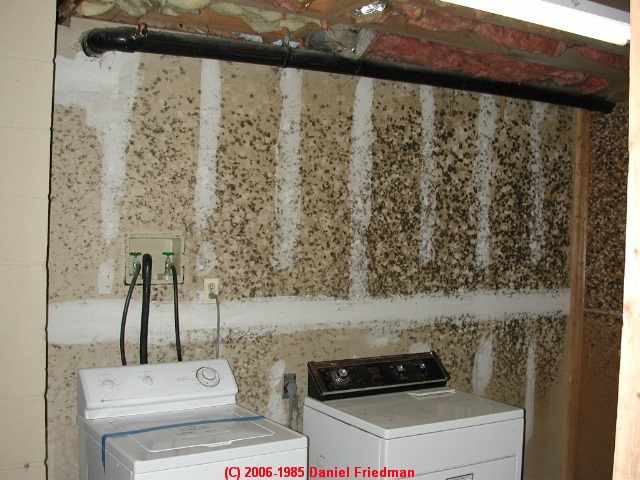
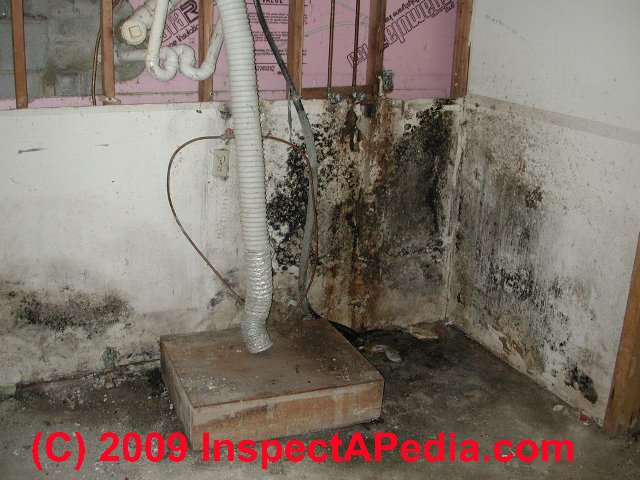
Mold on basement laundry room wall - Daniel Friedman 04-11-01
Black mold in the laundry room
 may look like this extensive case. In cases of large areas of visible mold, unless the mold proves to be only cosmetic mold, professional cleaning is probably needed.
Look closely when inspecting or collecting test samples of "toxic black mold" because often there are other molds, sometimes more harmful and more easily airborne mold species on the same surface, on the hidden side of the same surface of drywall, or nearby.
These include lighter colored genera/species of Aspergillus sp., Penicillium sp. etc. which are too often missed when investigators or building owners focus only on "black mold" testing.

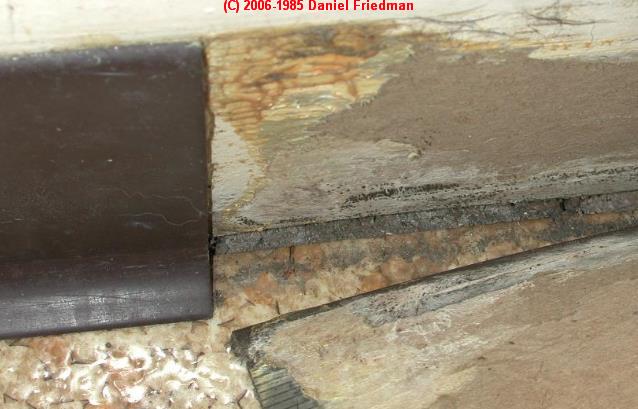
Stachybotrys behind baseboard - Daniel Friedman 04-11-01

Tiny Stachybotrys toxic black mold colony
 on drywall behind a laundry room baseboard. If this is all that's present this is a trivial cleanup and does not need testing and remediation.
But if this is a "tip of iceberg" clue of a larger hidden problem in the wall, or if it might be, further investigation, at least exploring the wall cavity, would be appropriate.


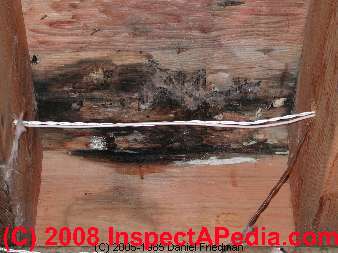
T Scriptis in rotting subfloor - Daniel Friedman 04-11-01
Black mold on rotting subfloor below a leaky sliding glass door - this "black mold" was Taeoniella rudus for which no medical issues have been reported - a wood rotting organism though.
An investigation of the source of outside leaks and extent of damage to the structure were needed at this building.
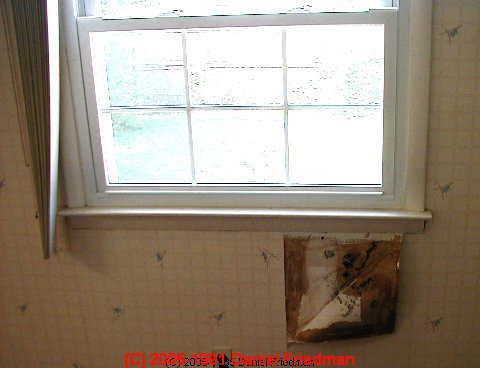
Black Stachybotrys chartarum black mold on wallpaper below a leaky window. The window had been left open more than once during rainy weather. We found that water was leaking into the wall cavity, not just behind the wallpaper.
Stachybotrys black mold on wallpaper - Daniel Friedman
04-11-01
Replacement of a small section of drywall, wall cavity insulation, and wallpaper were appropriate at this location where the first symptom was loose peeling wallpaper which exposed black mold.

Memnoniella echinata black mold in wall cav - Daniel Friedman
04-11-01
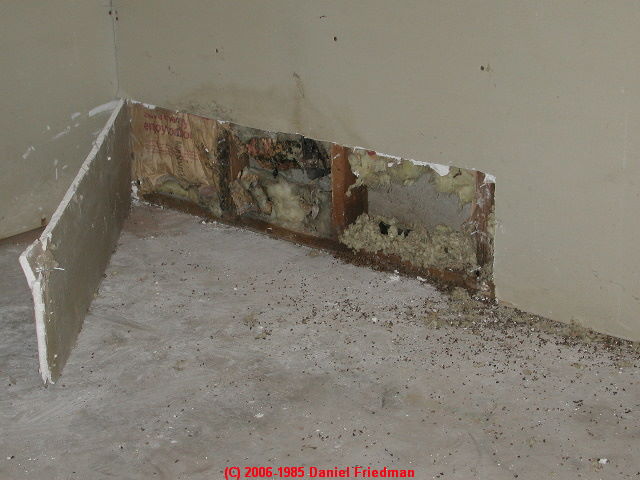
Toxic black mold, Memnoniella echinata
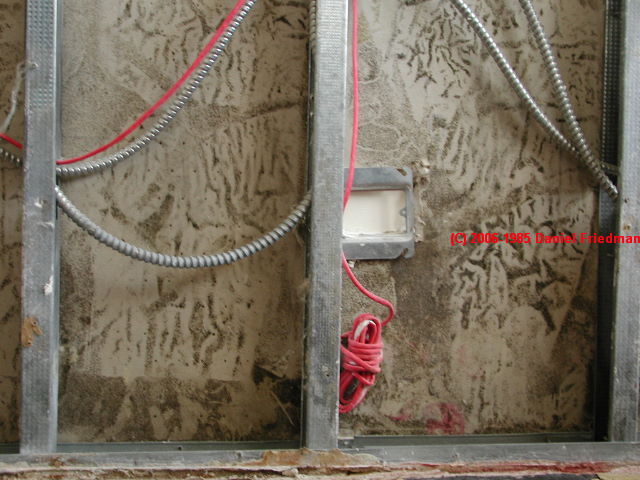
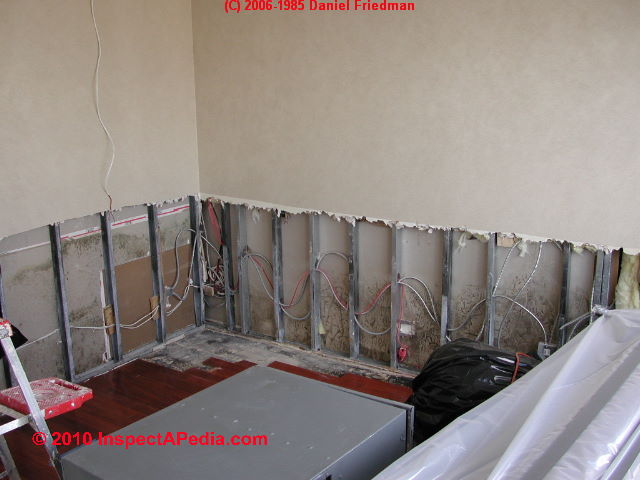
 visible at a small test cut into the wall cavity and contaminating fiberglass insulation in a NY City high rise apartment after water leaked from an A/C condensate line into the metal track of the metal-stud wall.
Larger wall cuts to look for hidden mold and final demolition exposed a very extensive toxic mold colony in this building. Lab processing of a tape sample of this mold was necessary to identify it.
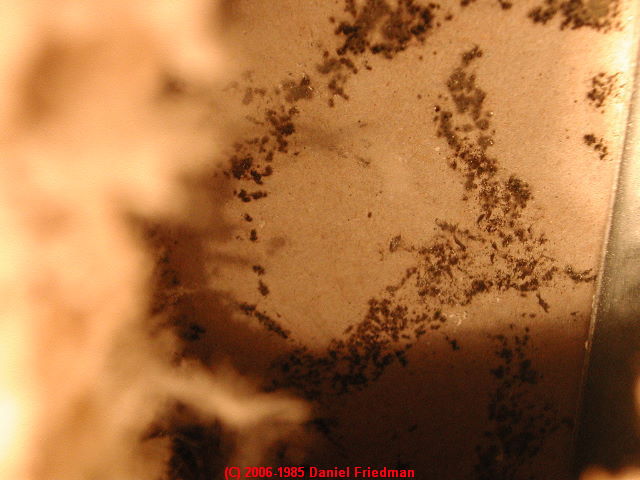
Notice the funny black mold growth pattern on the cavity side of the opposing drywall. This pattern maps the points of contact of the wall insulation kraft paper with the drywall surface, and the movement of moisture and spreading mold growth on the wall surface. It is characteristic of wall cavity mold and is different from the growth pattern of mold growing on a freely exposed-to-air drywall surface.

extensive mold hidden in fiberglass insulated wall cavity -
Daniel Friedman 04-11-01Black and hidden mold in fiberglass wall insulation
 in a basement exposed to prolonged wet conditions from a wall leak at a water pipe entry point. This mold was almost hidden except for a small mold-suspect patch and larger water stains on the exposed side of the drywall.
The wall cut exposed a surprise point of water entry. Black mold was visible on the insulation kraft paper.
The problematic mold in this case was not visible but was found by a special sampling technique we used to examine the building insulation for Aspergillus sp. and Penicillium sp. (problem molds) in the fiberglass. 
It was found to be highly contaminated and was determined to be an active reservoir releasing high levels of airborne mold into the basement.

More Photos & Close ups of Black Mold on Building Surfaces 

Black mold on drywall (C) Daniel Friedman Black mold on drywall (C) Daniel Friedman
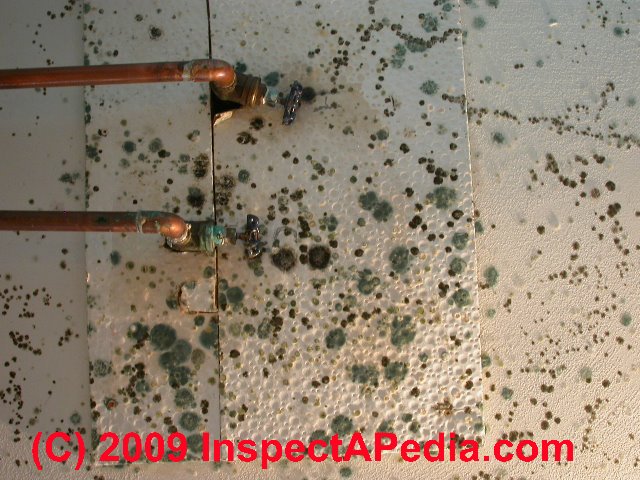
Our mold photo at above left shows black mold colonies growing among green mold colonies on a laundry room ceiling, covering both plastic ceiling tile material (around the plumbing pipes) and drywall. It is often the case that multiple mold genera/species may be growing in the same area, often on the same surface, and at times, on top of one another.
As we advised earlier, look closely when inspecting or collecting test samples of "toxic black mold" because often there are other molds, sometimes more harmful and more easily airborne mold species on the same surface, on the hidden side of the same surface of drywall, or nearby. In this building that was still wet at the time we took this photograph, the airborne level of Aspergillus sp. and Penicillium sp. (the green, gray, and light colored molds in the photo) was very high while the level of airborne Stachybotrys chartarum, Cladosporium sphaerospermum, and Nigrospora sp. (black molds found on these surfaces) was very low.
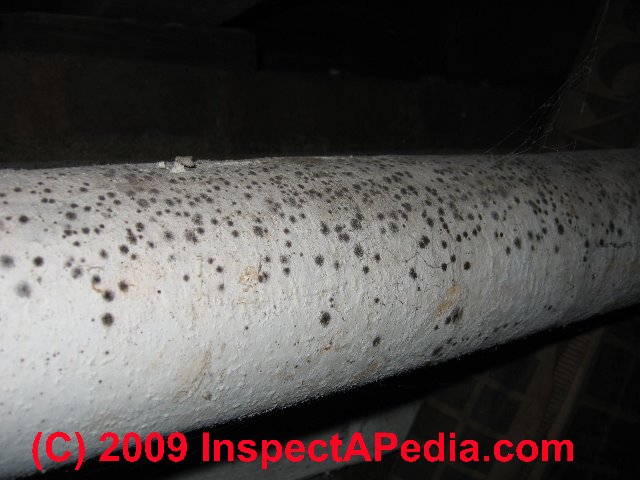
Our photo at above right shows black mold colonies as smaller "spots" growing on the painted surface of cloth covering asbestos pipe insulation.
Black mold on drywall (C) Daniel Friedman Black mold on drywall (C) Daniel Friedman
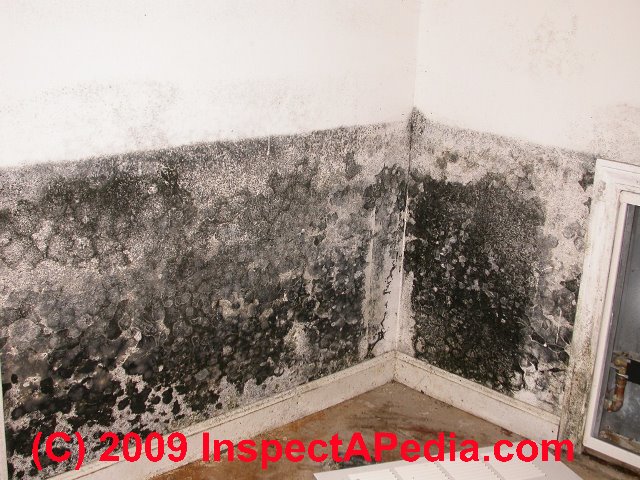
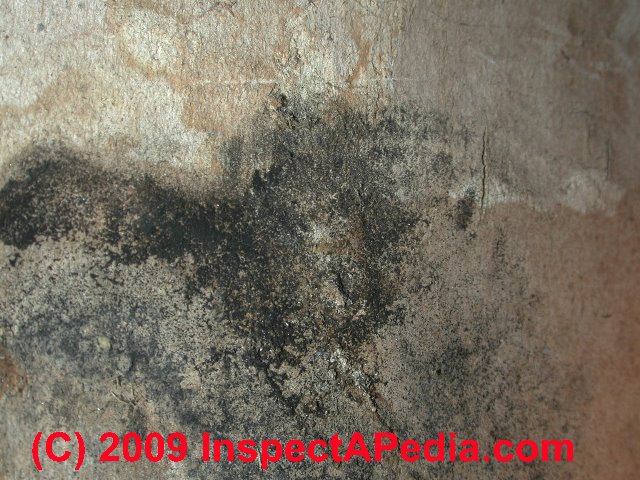
Our black mold photos above show dense black fungal growth on drywall (black mold on Sheetrock™ type wall surfaces) in areas that have been very wet. The distinct top edge of mold growth may mark a flood water level or a discontinuity in the wall material, such as a tape joint in drywall that affected the moisture gradient in the wall and thus the mold growth pattern.

Close up Photographs of Black Mold on Building Surfaces

Black mold on drywall (C) Daniel Friedman Black mold on drywall (C) Daniel Friedman
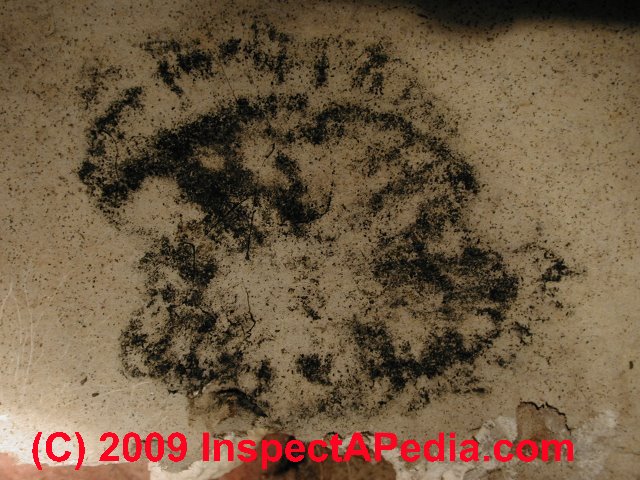
Here we begin to "zoom in for a closer look at dense black mold growth on indoor building surfaces in a wet basement. Notice that the mold growth on drywall and often on other surfaces includes a family of circular growth patterns (upper area of photo at above right) until the mold growth has expanded to form a solid black covering (left wall of photo at left and lower wall of black mold in photo at right).
Black mold on drywall (C) Daniel Friedman Black mold on drywall (C) Daniel Friedman
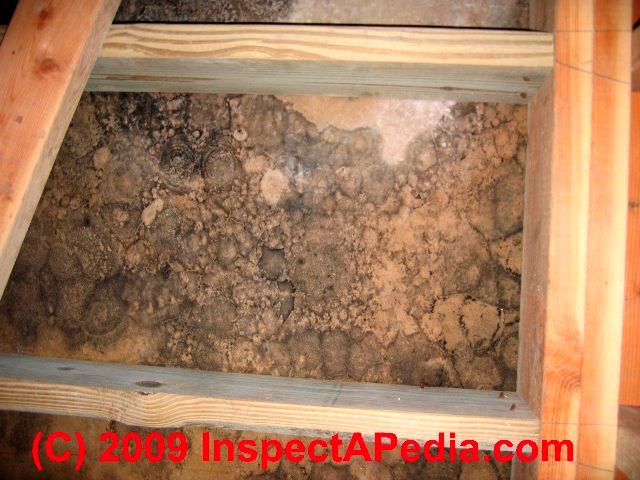
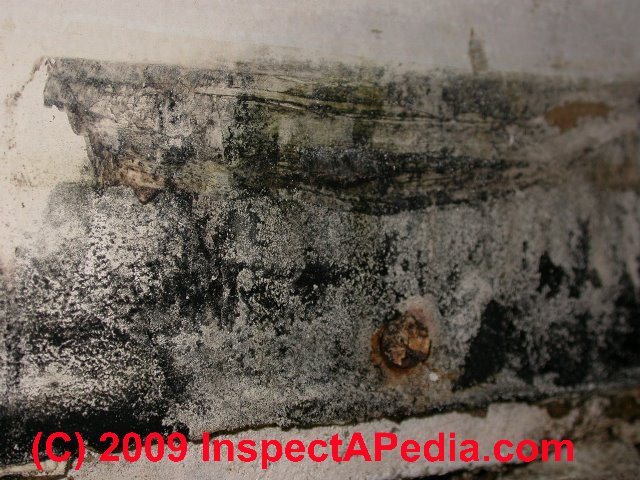
Our photo at above left shows black mold colonies as individual rounded "rings" on the cavity side of drywall on a building crawl area wall. The black mold photo at right shows how dense black mold may be hidden from view behind wall baseboard trim (removed for this picture) in a building that has suffered wet floors.
Black mold on furniture (C) Daniel Friedman Black mold on canvas clothing or bag (C) Daniel Friedman
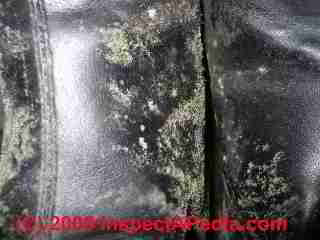
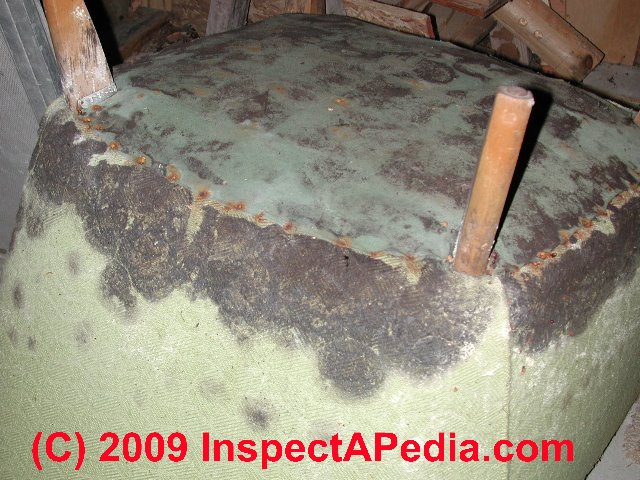
Black mold growth on furniture is obvious in these two photographs, of a mold on a leatherette surface (left) and on an upholstered chair (right).
Black mold on drywall (C) Daniel Friedman Black mold on drywall (C) Daniel Friedman
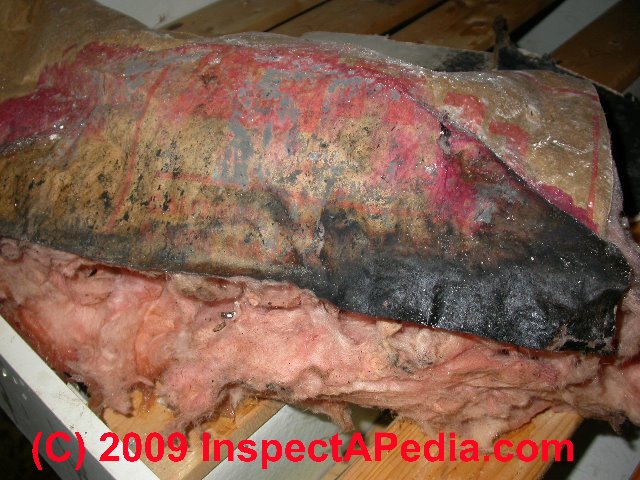
In our photo at above left we see black mold and other mold growths on the kraft paper facing of fiberglass building insulation. Our black mold photo at above right shows that mold colonies do not always grow in the neat round ring-like colonies shown in some our earlier photographs.
Black mold on drywall (C) Daniel Friedman Black mold on drywall (C) Daniel Friedman
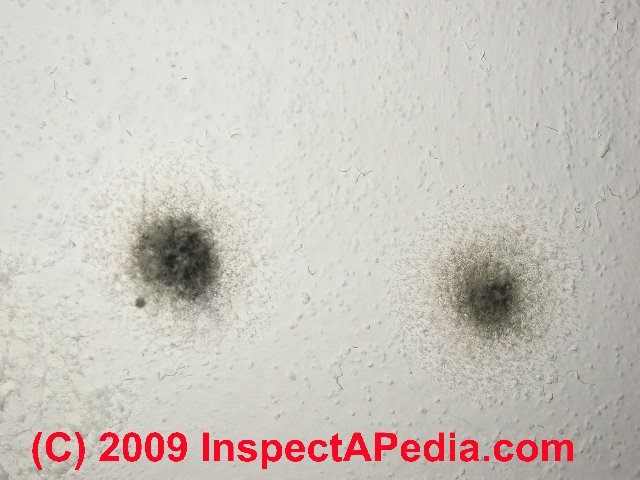
Here we start to zoom in our photographs of black mold on building surfaces to show what mold colonies look like on close inspection in-situ. At left is mold on water stained drywall in a basement utility area. At right are small mold colonies that have appeared on a kitchen ceiling in just a few days after a heating system leak led to high indoor moisture and humidity levels.
Closeup of Black mold growth on drywall (C) Daniel Friedman Black mold under the microscope (C) Daniel Friedman
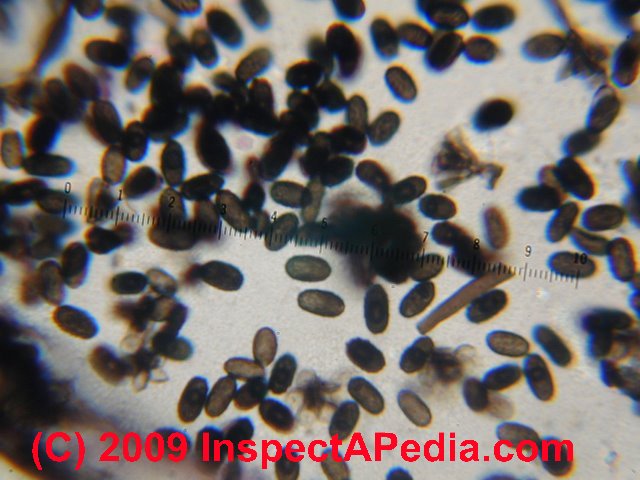
Much more closely we can examine an individual black mold colony on a painted drywall ceiling (above left). In the microscope at 1000x we can see individual spores of Stachybotrys chartarum - a well known black mold that is often found on indoor building surfaces.

Other Examples of What Mold Looks Like in Buildings

Question: Is this stuff on my ceiling mold?

Ceiling stains (C) InspectAPedia.com and L.B.I just moved into a rental trailer and it had a strong musty smell. I thought, maybe it hasn't been aired out. well, after two days of doors and windows open, it still smells. I found the brown discoloration on the ceiling in the kitchen cabinets. Is it mold? Thank you, - L.B. 

Reply: maybe not, but those water stains mean there may be a significant risk of hidden mold indoors

Your photo shows some heavy staining on what looks like suspended ceiling tiles. The brown stains themselves may not be mold but rather brown materials carried by roof leaks into the ceiling structure. Older trailers and mobile homes often have leaky roofs.
It looks as if water has also run down the wall surface and quite likely the wall cavity of the home below those same stains.
In this case the stains you see might not be mold but they do indicate that there is a high risk of mold in this home. Here are spots where I'd suspect a more hidden but possibly larger problem reservoir of mold when we see leak stains like yours:
  • The ceiling tiles may themselves be moldy on their upper or hidden surface, depending on what they are made-of. Even plastic-faced fiberglass suspended ceiling tiles that might not look moldy may in fact be contaminated if they have been wet.
    See INSULATION MOLD TEST.
  • The back side of wallpaper that has been soaked is often moldy.
    At HIDDEN MOLD in OTHER PLACES we include a photo of mold found behind wallpaper that looked just fine from the room side.
  • If the walls are covered with drywall behind that wallpaper, its cavity side may be moldy, though more likely your walls are paneled. Un-painted cavity side of wood paneling often supports mold growth and of course insulation within the wall cavity may be wet and moldy too.
  • Finally, where we see significant stains at a wall/ceiling juncture indicating a history of roof leaks that sent water into and down the wall, we take a close look at carpeting, carpet padding, and insulation that may be under the floor below.
I suggest having someone take a look at the insulation and floor condition in the area of leakage from below the mobile home. If that area is wet and damaged you can pretty much expect that there is hidden damage and mold in the ceiling and wall above.
If the damage is not so extensive that immediate major repairs to the structure are needed, but if there appears to be anything greater than 30 sq.ft. of moldy material, professional cleaning and repairs are needed. And the cleaning and repair work cannot be concluded before the leaks are fixed. 
Watch out: in some mobile homes where there has been chronic leakage we have seen floors that were badly deteriorated and even collapse.

Answers to Home Inspection Cost and Services

What is a home inspection?
A home inspection is an objective visual examination of the physical structure and systems of a house, from the roof to the foundation.


What does a home inspection include? 
The standard home inspector’s report will cover the condition of the home’s heating system; central air conditioning system (temperature permitting); interior plumbing and electrical systems; the roof, attic and visible insulation; walls, ceilings, floors, windows and doors; the foundation, basement and structural components.
The American Society of Home Inspectors (ASHI) publishes a Standards of Practiceand Code of Ethics that outlines what you should expect to be covered in your home inspection report.


Why do I need a home inspection?
Buying a home could be the largest single investment you will ever make. To minimize unpleasant surprises and unexpected difficulties, you’ll want to learn as much as you can about the newly constructed or existing house before you buy it. A home inspection may identify the need for major repairs or builder oversights, as well as the need for maintenance to keep it in good shape. After the inspection, you will know more about the house, which will allow you to make decisions with confidence.
If you already are a homeowner, a home inspection can identify problems in the making and suggest preventive measures that might help you avoid costly future repairs.
If you are planning to sell your home, a home inspection can give you the opportunity to make repairs that will put the house in better selling condition.


What will it cost?
The inspection fee for a typical one-family house varies geographically, as does the cost of housing. Similarly, within a given area, the inspection fee may vary depending on a number of factors such as the size of the house, its age and possible optional services such as septic, well or radon testing.

Do not let cost be a factor in deciding whether or not to have a home inspection or in the selection of your home inspector. The sense of security and knowledge gained from an inspection is well worth the cost, and the lowest-priced inspection is not necessarily a bargain. Use the inspector’s qualifications, including experience, training, compliance with your state’s regulations, if any, and professional affiliations as a guide.


Why can't I do it myself? 
Even the most experienced homeowner lacks the knowledge and expertise of a professional home inspector. An inspector is familiar with the elements of home construction, proper installation, maintenance and home safety. He or she knows how the home’s systems and components are intended to function together, as well as why they fail.

Above all, most buyers find it difficult to remain completely objective and unemotional about the house they really want, and this may have an effect on their judgment. For accurate information, it is best to obtain an impartial, third-party opinion by a professional in the field of home inspection.


Can a house fail a home inspection? 
No. A professional home inspection is an examination of the current condition of a house. It is not an appraisal, which determines market value. It is not a municipal inspection, which verifies local code compliance. A home inspector, therefore, will not pass or fail a house, but rather describe its physical condition and indicate what components and systems may need major repair or replacement.


What is ASHI?
Since 1976, ASHI has worked to build consumer awareness of home inspection and to enhance the professionalism of its membership. The ASHI Standards of Practice and Code of Ethics serves as a performance guideline for home inspectors, and is universally recognized and accepted by many professional and governmental bodies.
Back to top

Who belongs to ASHI? 
ASHI is an organization of independent, professional home inspectors who are required to make a commitment, from the day they join as ASHI Associates, to conduct inspections in accordance with the ASHI Standards of Practice and Code of Ethics, which prohibits engaging in conflict-of-interest activities that might compromise their objectivity. ASHI Associates work their way to ASHI Certified Inspector status as they meet rigorous requirements, including passing a comprehensive, written technical exam and performing a minimum of 250 professional, fee-paid home inspections conducted in accordance with the ASHI Standards of Practice and Code of Ethics. Mandatory continuing education helps the membership stay current with the latest in technology, materials and professional skills.
Back to top

When do I call a home inspector?
Typically, a home inspector is contacted immediately after the contract or purchase agreement has been signed. Before you sign, be sure there is an inspection clause in the sales contract, making your final purchase obligation contingent on the findings of a professional home inspection. This clause should specify the terms and conditions to which both the buyer and seller are obligated.
Back to top

Do I have to be there?
While it’s not required that you be present for the inspection, it is highly recommended. You will be able to observe the inspector and ask questions as you learn about the condition of the home and how to maintain it.
Back to top

What if the report reveals problems? 
No house is perfect. If the inspector identifies problems, it doesn’t mean you should or shouldn’t buy the house, only that you will know in advance what to expect. If your budget is tight, or if you don’t want to become involved in future repair work, this information will be important to you. If major problems are found, a seller may agree to make repairs.
Back to top

If the house proves to be in good condition, did I really need an inspection? 
Definitely. Now you can complete your home purchase with confidence. You’ll have learned many things about your new home from the inspector’s written report, and will have that information for future reference.
Back to top

Wednesday, November 19, 2014

Home Window Blinds and Child Safety


About once a month in the United States, a child between 7 months and 10 years old is strangled in the cords of window blinds and shades.
Typically, the child wraps the cord around his neck or pulls on cords—which are not clearly visible but are accessible—then gets tangled up in the loops. Strangulation deaths and injuries can happen quickly and silently, and they occur no matter how vigilant parents are. More than 180 kids were strangled in the cords from 1996 to 2012, according to the Consumer Product Safety Commission.
The CPSC has recalled (PDF) millions of window coverings with cords in recent years. Manufacturers operate under voluntary safety standards, a situation that does not adequately address the problems. The rate of injuries and death has not significantly declined over the years that Consumer Reports has covered the hazards of cords on window coverings.
Consumers Union, the policy and advocacy arm of Consumer Reports, has pressed companies to make window coverings safer, and we’re part of a coalition that has petitioned the CPSC to develop formal rules. The group includes the Consumer Federation of America, Independent Safety Consulting, Kids In Danger, Parents for Window Blind Safety, Public Citizen, and U.S. PIRG. In a unanimous vote last month, the CPSC agreed to move forward on our petition and begin the process of rulemaking.
The coalition has pointed to the fact that safer window coverings are already on the market and that such designs can be used on the vast majority of blinds and shades. Since the industry has resisted calls to eliminate dangerous cords even though those safer options exist, we believe a mandatory standard is necessary to ensure unsafe products will no longer be sold.
Consumers Union and other groups will continue to work to get a strong rule established as soon as possible.

How to keep your child safe

Follow this advice from the CPSC.

• Examine all shades and blinds in your home. The CPSC recommends cordless window coverings in all homes where children live or visit.

• Make sure there are no accessible cords on the front, side, or back of the window covering.

• Keep cribs, beds, and other furniture away from windows with shades or blinds. Children can climb on the furniture and gain access to the cords.

• Make loose cords inaccessible.

• If the window shade has looped bead chains or nylon cords, install tension devices to keep the cords taut.

To learn more about what you can do to avoid a tragedy in your home, visit the CPSC’s window covering information center.

Guaranteed Property Inspection & Mold Investigation Receives 2014 Best Businesses of Irvine Award

Press Release
FOR IMMEDIATE RELEASE
Guaranteed Property Inspection & Mold Investigation Receives 2014 Best Businesses of Irvine Award
Irvine Award Program Honors the Achievement
Irvine, November 19, 2014 — Guaranteed Property Inspection & Mold Investigation has been selected for the 2014 Best Businesses of Irvine Award in the Home Inspectors category by the Best Businesses of Irvine Award Program.
Each year, the Best Businesses of Irvine Award Program identifies companies that we believe have achieved exceptional marketing success in their local community and business category. These are local companies that enhance the positive image of small business through service to their customers and our community. These exceptional companies help make the Irvine area a great place to live, work and play.
Various sources of information were gathered and analyzed to choose the winners in each category. The 2014 Best Businesses of Irvine Award Program focuses on quality, not quantity. Winners are determined based on the information gathered both internally by the Best Businesses of Irvine Award Program and data provided by third parties.
About the Best Businesses of Irvine Award Program
The Best Businesses of Irvine Award Program is an annual awards program honoring the achievements and accomplishments of local businesses throughout the Irvine area. Recognition is given to those companies that have shown the ability to use their best practices and implemented programs to generate competitive advantages and long-term value.
The Best Businesses of Irvine Award Program was established to recognize the best of local businesses in our community. Our organization works exclusively with local business owners, trade groups, professional associations and other business advertising and marketing groups. Our mission is to recognize the small business community’s contributions to the U.S. economy.
SOURCE: Best Businesses of Irvine Award Program
CONTACT:
Best Businesses of Irvine Award Program
Email: PublicRelations@BestBusinesses.biz
URL: http://www.BestBusinesses.biz
###