Monday, March 16, 2015

Guaranteed Property Inspection & Mold Investigation Inc Receives 2014 Best Businesses of Irvine Award

Press Release

Press Release
FOR IMMEDIATE RELEASE
Guaranteed Property Inspection & Mold Investigation Inc Receives 2014 Best Businesses of Irvine Award
Irvine Award Program Honors the Achievement
Irvine, January 9, 2015 — Guaranteed Property Inspection & Mold Investigation Inc has been selected for the 2014 Best Businesses of Irvine Award in the Home Inspectors category by the Best Businesses of Irvine Award Program.
Each year, the Best Businesses of Irvine Award Program identifies companies that we believe have achieved exceptional marketing success in their local community and business category. These are local companies that enhance the positive image of small business through service to their customers and our community. These exceptional companies help make the Irvine area a great place to live, work and play.
Various sources of information were gathered and analyzed to choose the winners in each category. The 2014 Best Businesses of Irvine Award Program focuses on quality, not quantity. Winners are determined based on the information gathered both internally by the Best Businesses of Irvine Award Program and data provided by third parties.
About the Best Businesses of Irvine Award Program
The Best Businesses of Irvine Award Program is an annual awards program honoring the achievements and accomplishments of local businesses throughout the Irvine area. Recognition is given to those companies that have shown the ability to use their best practices and implemented programs to generate competitive advantages and long-term value.
The Best Businesses of Irvine Award Program was established to recognize the best of local businesses in our community. Our organization works exclusively with local business owners, trade groups, professional associations and other business advertising and marketing groups. Our mission is to recognize the small business community’s contributions to the U.S. economy.
SOURCE: Best Businesses of Irvine Award Program
CONTACT:
Best Businesses of Irvine Award Program
Email: PublicRelations@BestBusinesses.biz
URL: http://www.BestBusinesses.biz
###

Sunday, March 15, 2015

Results of Formaldehyde Testing of Building Liquidator Flooring

We have tested a number of homes for formaldehyde gas levels that have Building Liquidator flooring installed.

Our results so far show formaldehyde levels ranging from .095 ppm to .045 ppm.

These levels are  above California standard of .05 ppm., or within within the standard deviation. In addition, these levels are within the standard deviation of acceptable EPA levels of .1 ppm.

We have recommended that our clients take prompt action; e.g. removing the flooring promptly.

To test for formaldehyde in a home we use the following process that is conducted by a Certified Microbial Consultant. We charge $275 (in the Orange County area of California); which includes the test and written test results from an AHIA lab. Results take about 48 to 72 hours.


Formaldehyde Vapor Monitor

General
The Formaldehyde Vapor Monitor is used to measure personal exposure or room concentrations. This monitoring badge will be accepted in as accurate in any inspection or dispute, because it is validated for accuracy, and analyzed in an AIHA-LAP, LLC accredited laboratory.

Indoor Air Quality
For measurement of indoor air quality, The EPA and The American Lung Assoc. recommend a maximum level of 0.1 ppm; California recommend 0.05 ppm. Some people may be sensitive to lower levels. The monitoring badge is placed in a room with suspect flooring for about 24 hours. Then it will be accurate at a level of 0.003 ppm (3 parts per billion). For a 48 hour exposure, the minimum level is even lower.


OSHA Regulations
Each person who uses formaldehyde as a regular part of their job must have their exposure monitored periodically, according to OSHA regulations. 
There are two conditions that must be met to comply with the OSHA Standards for personal exposure in the workplace. First, the concentration for an 8 hour period must be less than 0.75 ppm. Second, the maximum exposure during any 15 minute interval must be less than 2.0 ppm. There is also an “action level” at 0.5 ppm for an 8 hour period. Above the action level more frequent monitoring is needed to avoid the need for protective equipment and for medical testing. 
The Formaldehyde Vapor Monitor meets OSHA accuracy requirements for both the full shift and short-term measurements.

Principle of Operation
Collection of formaldehyde vapor by diffusion in the monitor and collection on a chemical activated solid adsorbent. Analysis is done by methods validated for accuracy by The Occupational Safety & Health Administration (OSHA) and by The National Institute of Occupational Safety & Health (NIOSH).

Thursday, March 12, 2015

Formaldehyde Testing of Building Liquidators Flooring.

Yes we provide this type of testing.

The NIOSH approve testing cost is $195.

The test should be conducted for at least 24 hours.

Thursday, January 1, 2015

Real Estate Agent Home Inspector Referrals?


What's Wrong With A Real Estate Agent Recommending A Particular Home Inspector To A Prospective Home Buyer?

 Most real estate agencies work on an average commission of 5% paid by the seller of the property. On a house selling for $350,000 there is a potential commission of $17,500. (FYI, real estate commissions are negotiable.) Sometimes a selling agent will recommend particular home inspectors to a prospective buyer, sometimes a list of three is given out. Who are these recommended inspectors? How did they "qualify" to get on the "approved" list of the agent? Is the agent recommending a thorough non-bias inspector or is the agent recommending someone who will help protect the potential commission? Unfortunately, for the prospective home buyer, some real estate agents view a thorough and non-bias home inspection as a threat to their sales commission.

Do prospective home buyers have the right to use an inspector of their own choosing? 

If a real estate agent tells you that you cannot use an inspector of your choosing, or insists that you use one of their "recommended" or "approved" inspectors, you should contact your attorney. A real estate broker or sales agent who tries to get you to use an inspector of the agent's choice is trying to control the home inspector selection process. Prospective home buyers must keep in mind that real estate agents who receive a commission from the property seller, are working in the best interest of their client, (the seller.) As the prospective home buyer, you are a customer of the agent, not a client. As the prospective home buyer, shouldn't the home inspector you're paying for, be working in your best interest?

What Is A "Deal Killer"? 

The derogatory phrase "deal killer" is often used by real estate agents to describe independent home inspectors who give buyers objective information in an inspection report, which may lead the buyer to renegotiate or to look at other properties. Many real estate agents view independent home inspectors as a challenge to their ability to generate income. They view these "deal killers" as foes and will use a number of tactics to control the inspector selection process to make sure that the prospective buyers do not retain independent home inspectors.

How Does A Real Estate Agent Control The Inspector Selection Process? 

There are many tactics used, some subtle and some not so subtle. The agent may discourage the potential buyer from using a certain inspector by making comments like: "That inspector is a deal killer", or "that inspector takes too long" or "we've had trouble with that inspector" or "we don't allow that inspector to inspect any of our listed properties" or "that inspector is too expensive." A twist on the fee tactic is to advise the prospective buyer that they should expect a home inspector to charge around $150 or $200. By advising home buyers to expect these low (unrealistic) fees, agents are trying to steer home buyers to certain inspectors, because the prospective home buyers might limit their search to the "arbitrary" price range set by the real estate agent.

The tactics used to encourage a prospective buyer to use a particular inspector include: "We've had good luck with this inspector" or "this inspector has the lowest fee" or "we use this inspector all the time" or "this inspector only takes an hour and he gives you a report right on the spot." For instance, in the first stage of discussion about having the home inspected, the real estate agent may recommend to the buyer a "good" home inspector with whom they have worked with for several years. Some agents may have a list of three inspectors who have been carefully screened not to be deal killers. The list, however, will be long enough to protect the agent from any referral liability should the buyer want to blame the agent for any inspection mistakes. This gives the agent the perfect combination of: A) No liability for the referral; B) The buyer "chooses" an inspector the agent prefers; and C) The buyer's choice is limited to home inspectors who will not hurt the sale.


Why Don't I Read About This Conflict Of Interest Situation In The Newspaper? 

Simple answer, money! Look at the real estate section of any local newspaper, lots of houses being advertised by real estate agents. Those newspapers don't run those ads for free. How many home inspector advertisements do you see in the newspapers? None. Do you think a newspaper is going to bite the hand that helps feed it?

Choose your own inspector! Too find a properly independent certified inspector visit the American Society of Home Inspectors website at: ASHI.org


Keep the cold at bay with these ASHI home winterizing tips

Keep the cold at bay with these ASHI home winterizing tips


Winter's frigid temperatures are on their way, and if you wait until the cold hits to finally start winterizing your home, it may already be too late to prevent home damage.

Getting started on your seasonal winterizing checklist early will help you prevent costly repairs in the spring. To help you properly winterize your home and prepare for the colder months, the American Society of Home Inspectors ASHI advises you to CHILL by following these tips:

* C: Caulk cracks to stop chilly drafts. Worn-out weather stripping around doors and windows allows cold air to seep into the home, which increases heating costs.

* H: Hustle on important repairs. Get going on those tricky repairs, such as putting insulation around your pipes. Not sure where to start? ASHI recommends a home inspection approximately every four years; this can point you in the right direction.

* I: Inspect your fireplace and flue. Test your fireplace flues for tight seals. If you're feeling a breeze even when the damper is closed, the flue could be warped, worn or even rusted.

* L: Look for deck decay and damage. Fixing any splintering, decay or insect damage on your deck this fall can prevent further deterioration during the winter.

* L: Light your fireplace and chill out. Stay warm this winter and build a fire in your family's fireplace. First check your smoke alarms. You probably will find all of your smoke alarms have ionization detectors. Throw all of them in the trash, even if they are brand new. Replace them with photoelectric alarms. Ionization alarms will let you know when you have burned the toast, but they may not alarm you if you have a deadly, smoldering fire in the middle of the night.

Home Winter Energy Saving Investments

Stay Warm this Winter with these Energy-Saving Investments
Do you need any new appliances, or are you planning to do some remodeling? Consider these energy efficiency suggestions before you purchase.

Choose ENERGY STAR appliances and electronics.When buying new appliances, choose ENERGY STAR-certified models. For example, a new ENERGY STAR refrigerator uses about 20 percent less energy than a standard new refrigerator, and 46 percent less than one made in 1980. A new Energy Star® clothes washer uses nearly 50 percent less energy than a standard washer.

Install a programmable thermostat. If you have a heat pump, select a model designed for heat pumps. Setback thermostats can save up to 15 percent on energy costs.

Increase ceiling insulation.
 If your ceiling is uninsulated or scantily insulated, consider increasing your insulation to up to R-38 to reduce heating costs by 5 to 25 percent.

Seal ducts. Leaking ductwork accounts for more than 25 to 30 percent of heating costs in an average California home. Consider hiring a contractor to test the tightness of your ducts and repair leaks and restrictions in your duct. Many utility companies have programs to assist you.

High-efficiency windows. If you are planning to replace your windows, choosing ENERGY STAR windows can reduce your heating and cooling costs by up to 15 percent.

Thursday, November 27, 2014

What mold contamination looks like in a home

Photographs to Help Identify Mold in Buildings - What mold contamination looks like in a home

Directories of 6 atlases or indices of building mold

Black mold on drywall (C) Daniel Friedman
  1. MOLD ATLAS & PARTICLES INDEX - A-to-Z Mold Atlas of Indoor Clinical Mold, Pathogens, Allergens & Other Indoor Particles
  2. MOLD APPEARANCE - WHAT MOLD LOOKS LIKE - What Does Black or Dark Indoor Mold Look Like? Black Mold spores in the Home - a Photo ID Library. What toxic black mold or other indoor mold looks like in buildings.
  3. MOLD GROWTH on SURFACES, PHOTOS - What Does Mold Look Like on Various Materials & Surfaces? An extensive photographic guide to mold as it is found growing on various building materials & surfaces.

    Also see MOLD GROWTH on SURFACES, TABLE OF - a Table of Kinds of Mold Growth Found on Building Surfaces, lists mold genera/species most often found on specific building surfaces, materials, or contents
  4. MOLD in the PETRI DISH, PHOTOS. - Photographs of Mold Growing on Petri Dishes or Mold Culture Plates or Settlement Plates
  5. MOLD by MICROSCOPE - Mold spores under the Microscope - a Photo ID Library for detection and identification of toxic or other mold
  6. MOLD RELATED ILLNESS SYMPTOMS - Mold Related Illness: Index of Symptoms. Readers should not rely on this document for medical diagnosis and instead should consult with their physician or with a specialist such as a medical toxicologist

Identification Photographs of Black Mold in Buildings - what does black mold look like?

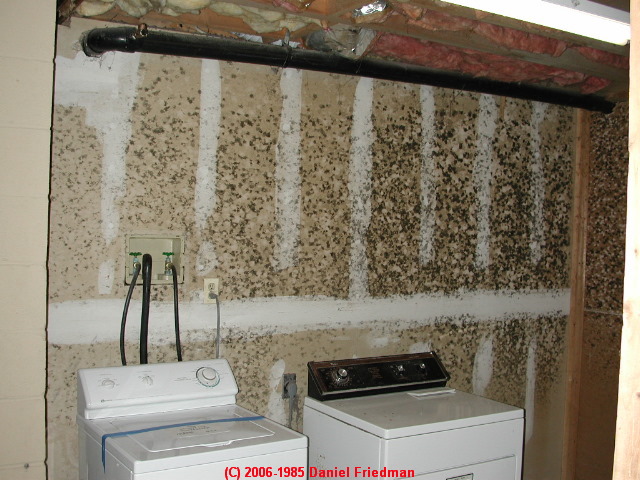
Mold on basement laundry room wall - Daniel Friedman 04-11-01
Black mold in the laundry room
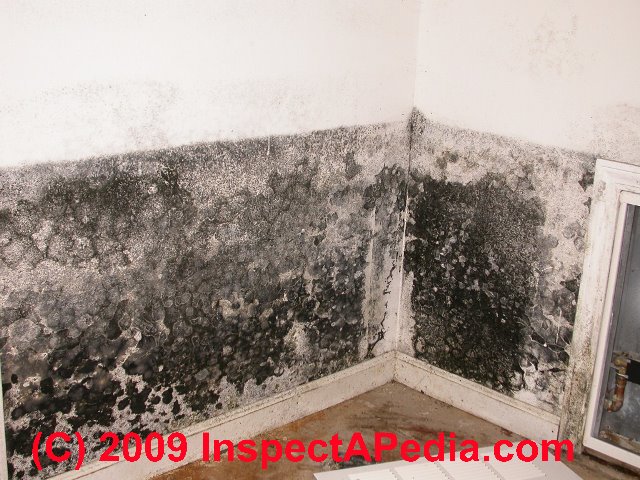
 may look like this extensive case. In cases of large areas of visible mold, unless the mold proves to be only cosmetic mold, professional cleaning is probably needed.
Look closely when inspecting or collecting test samples of "toxic black mold" because often there are other molds, sometimes more harmful and more easily airborne mold species on the same surface, on the hidden side of the same surface of drywall, or nearby.
These include lighter colored genera/species of Aspergillus sp., Penicillium sp. etc. which are too often missed when investigators or building owners focus only on "black mold" testing.

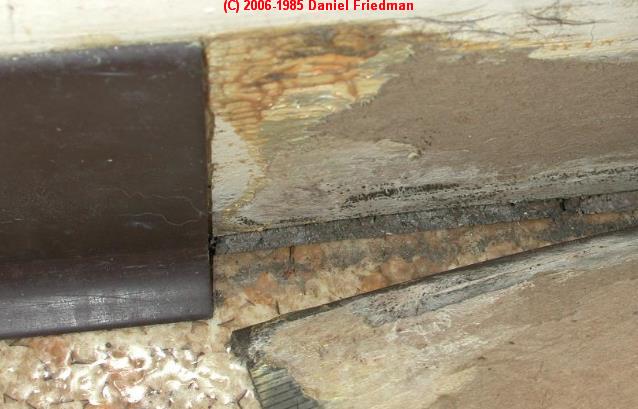
Stachybotrys behind baseboard - Daniel Friedman 04-11-01

Tiny Stachybotrys toxic black mold colony
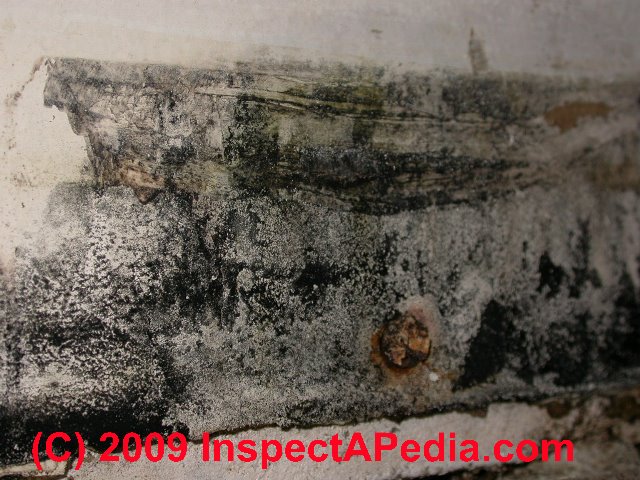
 on drywall behind a laundry room baseboard. If this is all that's present this is a trivial cleanup and does not need testing and remediation.
But if this is a "tip of iceberg" clue of a larger hidden problem in the wall, or if it might be, further investigation, at least exploring the wall cavity, would be appropriate.


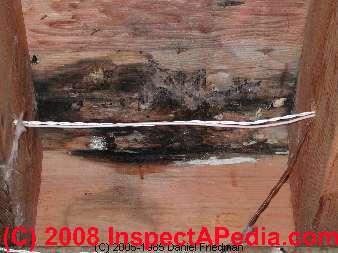
T Scriptis in rotting subfloor - Daniel Friedman 04-11-01
Black mold on rotting subfloor below a leaky sliding glass door - this "black mold" was Taeoniella rudus for which no medical issues have been reported - a wood rotting organism though.
An investigation of the source of outside leaks and extent of damage to the structure were needed at this building.
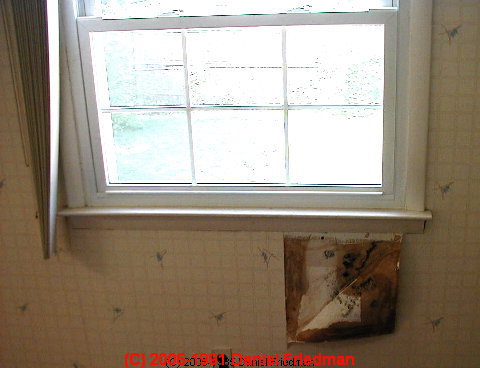
Black Stachybotrys chartarum black mold on wallpaper below a leaky window. The window had been left open more than once during rainy weather. We found that water was leaking into the wall cavity, not just behind the wallpaper.
Stachybotrys black mold on wallpaper - Daniel Friedman
04-11-01
Replacement of a small section of drywall, wall cavity insulation, and wallpaper were appropriate at this location where the first symptom was loose peeling wallpaper which exposed black mold.

Memnoniella echinata black mold in wall cav - Daniel Friedman
04-11-01
Toxic black mold, Memnoniella echinata
 visible at a small test cut into the wall cavity and contaminating fiberglass insulation in a NY City high rise apartment after water leaked from an A/C condensate line into the metal track of the metal-stud wall.
Larger wall cuts to look for hidden mold and final demolition exposed a very extensive toxic mold colony in this building. Lab processing of a tape sample of this mold was necessary to identify it.
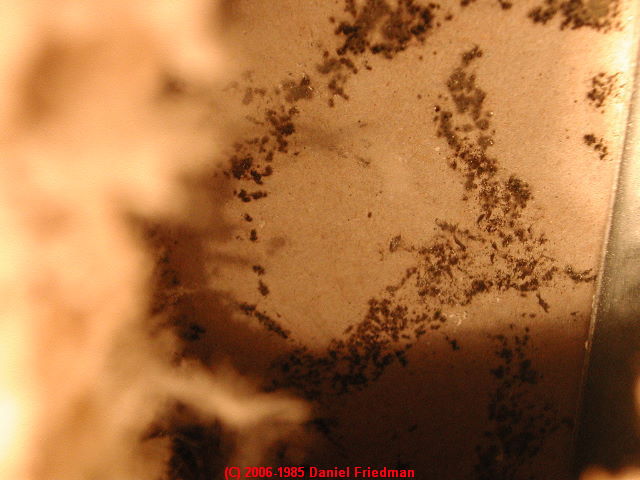
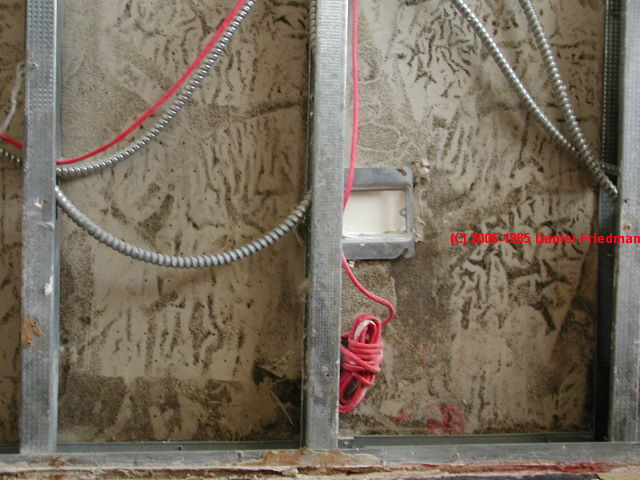
Notice the funny black mold growth pattern on the cavity side of the opposing drywall. This pattern maps the points of contact of the wall insulation kraft paper with the drywall surface, and the movement of moisture and spreading mold growth on the wall surface. It is characteristic of wall cavity mold and is different from the growth pattern of mold growing on a freely exposed-to-air drywall surface.

extensive mold hidden in fiberglass insulated wall cavity -
Daniel Friedman 04-11-01Black and hidden mold in fiberglass wall insulation
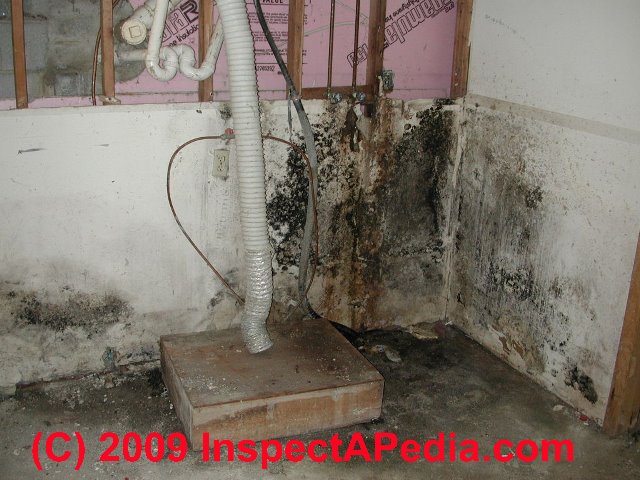
 in a basement exposed to prolonged wet conditions from a wall leak at a water pipe entry point. This mold was almost hidden except for a small mold-suspect patch and larger water stains on the exposed side of the drywall.
The wall cut exposed a surprise point of water entry. Black mold was visible on the insulation kraft paper.
The problematic mold in this case was not visible but was found by a special sampling technique we used to examine the building insulation for Aspergillus sp. and Penicillium sp. (problem molds) in the fiberglass. 
It was found to be highly contaminated and was determined to be an active reservoir releasing high levels of airborne mold into the basement.

More Photos & Close ups of Black Mold on Building Surfaces 

Black mold on drywall (C) Daniel Friedman Black mold on drywall (C) Daniel Friedman
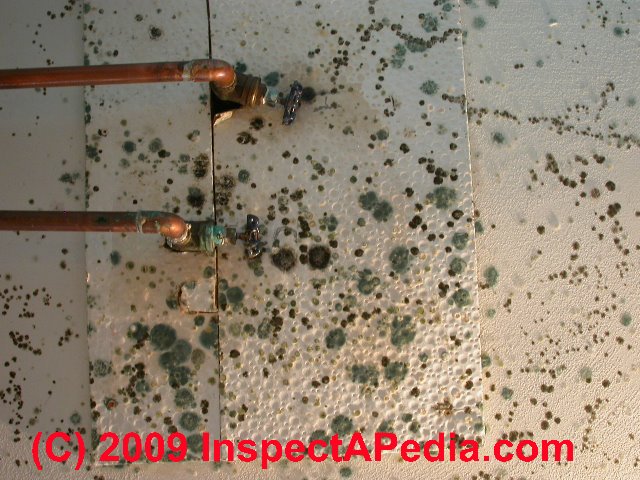
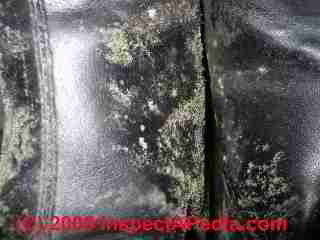
Our mold photo at above left shows black mold colonies growing among green mold colonies on a laundry room ceiling, covering both plastic ceiling tile material (around the plumbing pipes) and drywall. It is often the case that multiple mold genera/species may be growing in the same area, often on the same surface, and at times, on top of one another.
As we advised earlier, look closely when inspecting or collecting test samples of "toxic black mold" because often there are other molds, sometimes more harmful and more easily airborne mold species on the same surface, on the hidden side of the same surface of drywall, or nearby. In this building that was still wet at the time we took this photograph, the airborne level of Aspergillus sp. and Penicillium sp. (the green, gray, and light colored molds in the photo) was very high while the level of airborne Stachybotrys chartarumCladosporium sphaerospermum, and Nigrospora sp. (black molds found on these surfaces) was very low.
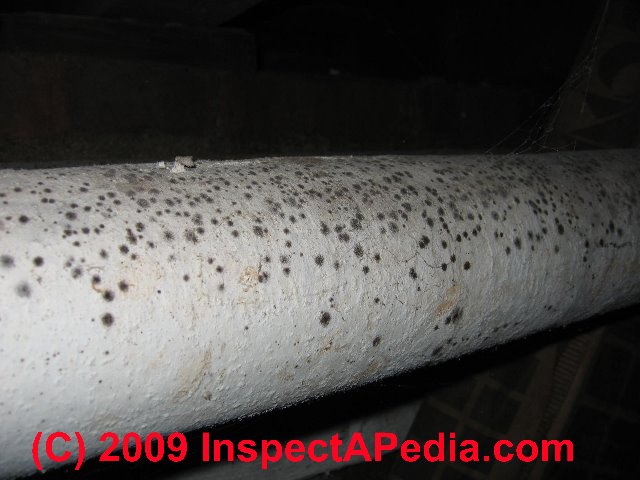
Our photo at above right shows black mold colonies as smaller "spots" growing on the painted surface of cloth covering asbestos pipe insulation.
Black mold on drywall (C) Daniel Friedman Black mold on drywall (C) Daniel Friedman
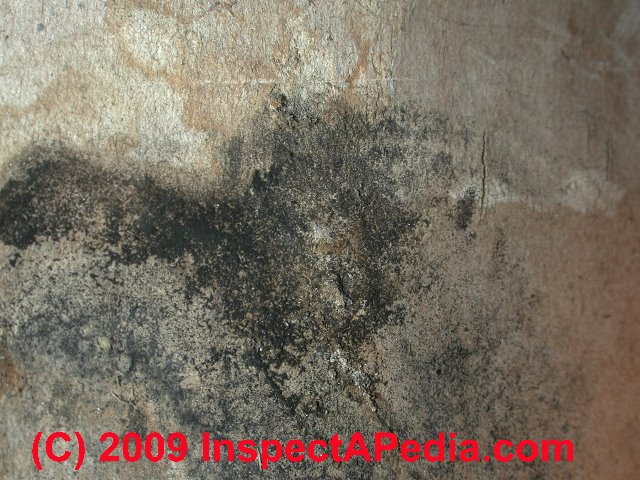
Our black mold photos above show dense black fungal growth on drywall (black mold on Sheetrock™ type wall surfaces) in areas that have been very wet. The distinct top edge of mold growth may mark a flood water level or a discontinuity in the wall material, such as a tape joint in drywall that affected the moisture gradient in the wall and thus the mold growth pattern.

Close up Photographs of Black Mold on Building Surfaces

Black mold on drywall (C) Daniel Friedman Black mold on drywall (C) Daniel Friedman
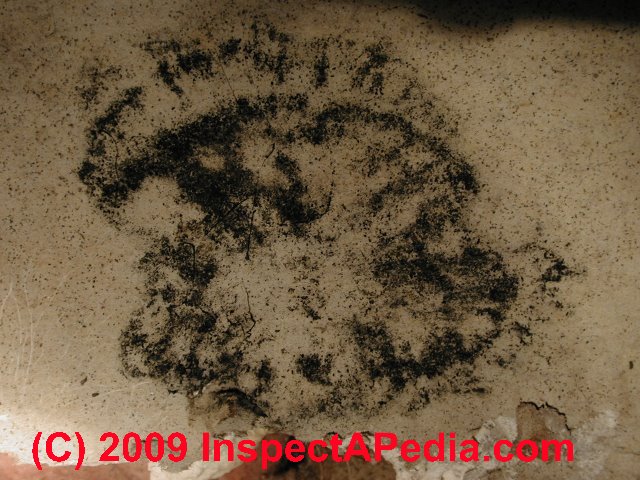
Here we begin to "zoom in for a closer look at dense black mold growth on indoor building surfaces in a wet basement. Notice that the mold growth on drywall and often on other surfaces includes a family of circular growth patterns (upper area of photo at above right) until the mold growth has expanded to form a solid black covering (left wall of photo at left and lower wall of black mold in photo at right).
Black mold on drywall (C) Daniel Friedman Black mold on drywall (C) Daniel Friedman
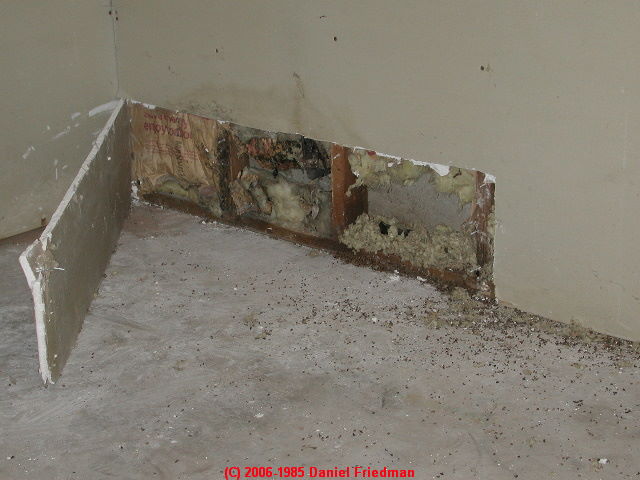
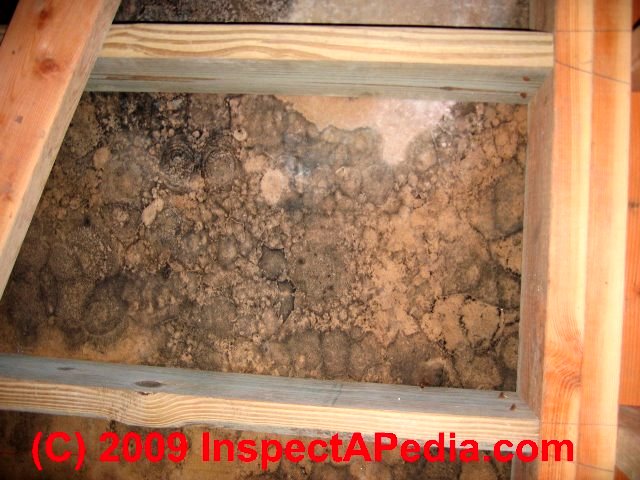
Our photo at above left shows black mold colonies as individual rounded "rings" on the cavity side of drywall on a building crawl area wall. The black mold photo at right shows how dense black mold may be hidden from view behind wall baseboard trim (removed for this picture) in a building that has suffered wet floors.
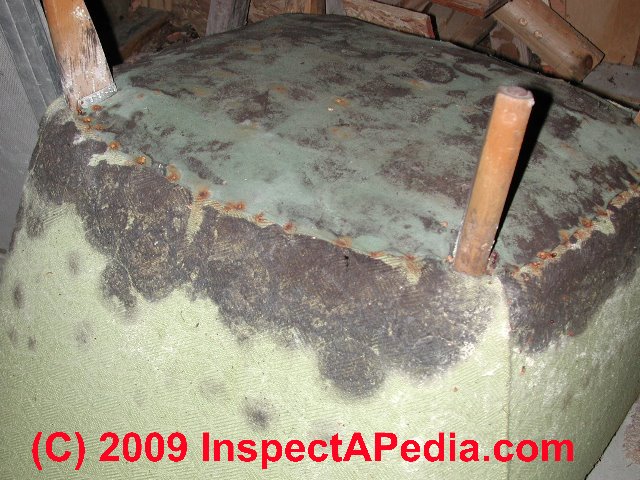
Black mold on furniture (C) Daniel Friedman Black mold on canvas clothing or bag (C) Daniel Friedman
Black mold growth on furniture is obvious in these two photographs, of a mold on a leatherette surface (left) and on an upholstered chair (right).
Black mold on drywall (C) Daniel Friedman Black mold on drywall (C) Daniel Friedman
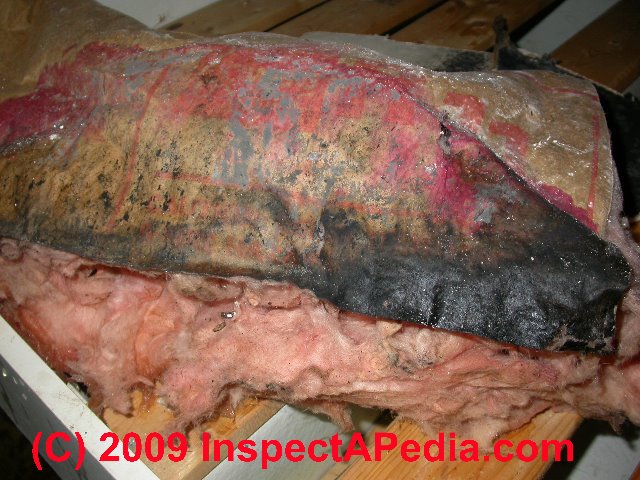
In our photo at above left we see black mold and other mold growths on the kraft paper facing of fiberglass building insulation. Our black mold photo at above right shows that mold colonies do not always grow in the neat round ring-like colonies shown in some our earlier photographs.
Black mold on drywall (C) Daniel Friedman Black mold on drywall (C) Daniel Friedman
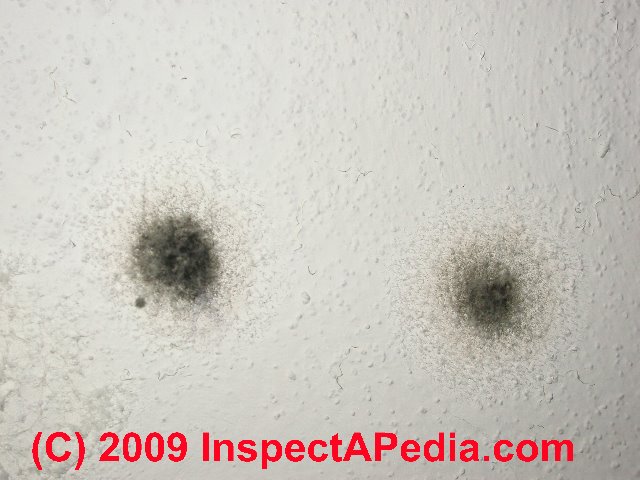
Here we start to zoom in our photographs of black mold on building surfaces to show what mold colonies look like on close inspection in-situ. At left is mold on water stained drywall in a basement utility area. At right are small mold colonies that have appeared on a kitchen ceiling in just a few days after a heating system leak led to high indoor moisture and humidity levels.
Closeup of Black mold growth on drywall (C) Daniel Friedman Black mold under the microscope (C) Daniel Friedman
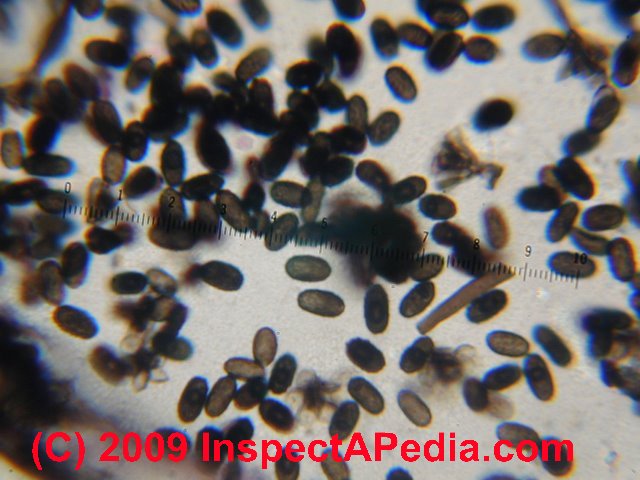
Much more closely we can examine an individual black mold colony on a painted drywall ceiling (above left). In the microscope at 1000x we can see individual spores of Stachybotrys chartarum - a well known black mold that is often found on indoor building surfaces.

Other Examples of What Mold Looks Like in Buildings

Question: Is this stuff on my ceiling mold?

Ceiling stains (C) InspectAPedia.com and L.B.I just moved into a rental trailer and it had a strong musty smell. I thought, maybe it hasn't been aired out. well, after two days of doors and windows open, it still smells. I found the brown discoloration on the ceiling in the kitchen cabinets. Is it mold? Thank you, - L.B. 

Reply: maybe not, but those water stains mean there may be a significant risk of hidden mold indoors

Your photo shows some heavy staining on what looks like suspended ceiling tiles. The brown stains themselves may not be mold but rather brown materials carried by roof leaks into the ceiling structure. Older trailers and mobile homes often have leaky roofs.
It looks as if water has also run down the wall surface and quite likely the wall cavity of the home below those same stains.
In this case the stains you see might not be mold but they do indicate that there is a high risk of mold in this home. Here are spots where I'd suspect a more hidden but possibly larger problem reservoir of mold when we see leak stains like yours:
  • The ceiling tiles may themselves be moldy on their upper or hidden surface, depending on what they are made-of. Even plastic-faced fiberglass suspended ceiling tiles that might not look moldy may in fact be contaminated if they have been wet.
    See INSULATION MOLD TEST.
  • The back side of wallpaper that has been soaked is often moldy.
    At HIDDEN MOLD in OTHER PLACES we include a photo of mold found behind wallpaper that looked just fine from the room side.
  • If the walls are covered with drywall behind that wallpaper, its cavity side may be moldy, though more likely your walls are paneled. Un-painted cavity side of wood paneling often supports mold growth and of course insulation within the wall cavity may be wet and moldy too.
  • Finally, where we see significant stains at a wall/ceiling juncture indicating a history of roof leaks that sent water into and down the wall, we take a close look at carpeting, carpet padding, and insulation that may be under the floor below.
I suggest having someone take a look at the insulation and floor condition in the area of leakage from below the mobile home. If that area is wet and damaged you can pretty much expect that there is hidden damage and mold in the ceiling and wall above.
If the damage is not so extensive that immediate major repairs to the structure are needed, but if there appears to be anything greater than 30 sq.ft. of moldy material, professional cleaning and repairs are needed. And the cleaning and repair work cannot be concluded before the leaks are fixed. 
Watch out: in some mobile homes where there has been chronic leakage we have seen floors that were badly deteriorated and even collapse.